 How-to
How to Avoid Roofing Repair Scams: 2026 Guide
Table of Contents
- How to Avoid Roofing Repair Scams: A Step-by-Step Approach
- Roofing Contractor Red Flags: Warning Signs to Watch For
- How to Verify a Roofing Contractor Before You Hire
- Your Roofing Estimate Checklist: What a Legitimate Quote Includes
- How to Document Roof Damage Independently
- Insurance Claim Boundaries and Your Rights as a Homeowner
- What to Do After a Roofing Scam: Immediate Steps
- Frequently Asked Questions
Last Updated: October 14, 2026
How to Avoid Roofing Repair Scams: A Step-by-Step Approach
Learning how to avoid roofing repair scams starts with one rule: slow down.
Roofing repair scams are fake or bad-faith roofing offers that use pressure, fake damage claims, or insurance tricks to take your money.
A common approach is to treat every unsolicited offer as a red flag until proven otherwise.
Below, we'll show you exactly how to spot these schemes, verify a contractor, and protect your home.
Roofing Contractor Red Flags: Warning Signs to Watch For
The clearest roofing contractor red flags show up before any work begins. If you see even one, pause the whole project.
Here's what to watch for:
- Door-to-door solicitation after a storm, claiming they "just finished a job nearby"
- Unsolicited calls or text messages offering a free inspection
- High-pressure sales with a "today only" discount
- Claims of hidden damage you can't see yourself
- A demand for upfront payment or a large cash deposit
- No local address, just a phone number and a magnetic sign
- Offers to waive your deductible or "handle the insurance company for you"
That last one is a serious problem. A deductible waiver is often insurance fraud, and it can leave you holding the bag.
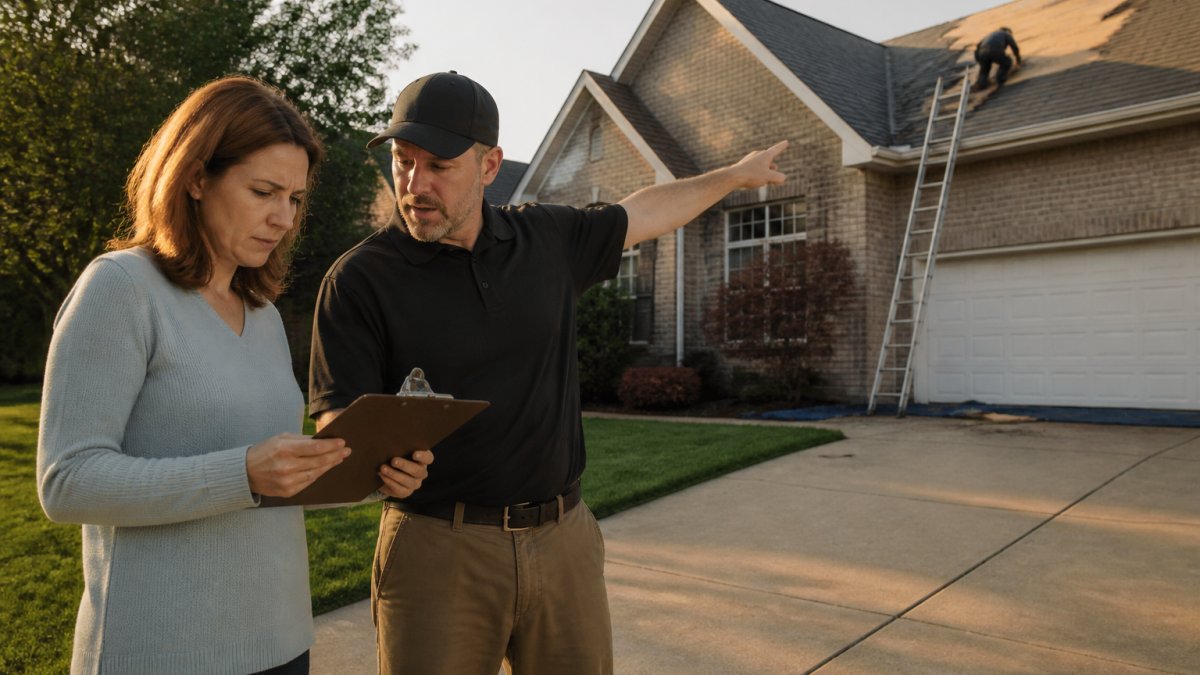
How to Verify a Roofing Contractor Before You Hire
Verifying a roofing contractor takes about 30 minutes and saves you thousands. Do it before you sign anything, and do it yourself, never let the contractor run the check for you.
Start with the basics:
- License: Check your state or local licensing board for an active license
- Proof of insurance: Ask for a certificate of liability insurance and workers' compensation coverage
- References: Request recent customers you can actually call
- Online reviews: Read more than the star rating, and look at how they respond to complaints
- Business card and address: Confirm a real physical location
- Written estimate: Get the scope of work in writing, not just a verbal price
The FTC's consumer guidance on home improvement scams explains why you should never pay in full upfront.
How to Actually Run Each Check
Most guides tell you to "check the license" and stop there.
License. Roofing licensing is not uniform.
Insurance. Ask for two separate documents, not one:
- A certificate of liability insurance showing general liability coverage, with you or your property listed as additional insured for the project if possible
- A certificate of workers' compensation coverage
These are not the same thing. Liability insurance protects your home if the crew damages it.
References. Ask for three recent customers whose roofs were similar to yours, same material, similar pitch, similar scope.
Reviews. Read reviews on more than one platform, and sort by lowest rating first.
Address. Confirm a real physical location, not a mailbox or a virtual office.
Step-by-Step Contractor Verification Checklist
Use this checklist before you hire anyone:
- Search your state or local licensing board by the company's legal name
- Confirm the license is active and classified for roofing
- Get a certificate of liability insurance and call the agent to confirm it's active
- Get a certificate of workers' compensation coverage
- Call at least two recent customers with similar roofs
- Read reviews on more than one site, lowest ratings first
- Verify a real local business address
- Get a written estimate with a full scope of work
- Read the cancellation terms
- Never pay more than a small deposit upfront
If a contractor dodges any of these, that's your answer.
Your Roofing Estimate Checklist: What a Legitimate Quote Includes
A legitimate roofing estimate is written, itemized, and clear about what's included. If it's a number scribbled on a business card, it's not an estimate.
A solid quote should spell out:
- Scope of work: what gets repaired or replaced, and where
- Materials: brand, type, and grade of shingles or materials
- Timeline: start date and expected completion
- Payment schedule: tied to milestones, not all upfront
- Warranty: what's covered and for how long
- Cleanup and disposal: who hauls away old materials
Watch for an unusually low bid. It usually means cheap materials or corners cut somewhere you can't see.
Contract Review and Payment Safeguards
Read the contract before you sign, and never sign on the first visit. Look for these safeguards:
- A clear payment schedule with a small deposit
- No full payment until the job passes inspection
- Cancellation terms you understand
- A written start and end date
- A lien waiver so suppliers can't come after you
Milestone Payments: How to Structure Them
Paying the full amount upfront is the single biggest mistake homeowners make. A safer structure ties each payment to a completed, verifiable milestone:
- Deposit: a small amount at signing, enough to cover materials, not the whole job
- Materials delivered: a payment when materials arrive on site and you can see them
- Mid-project: a payment when the tear-off and decking work is done and inspected
- Substantial completion: a payment when the roof is installed and passes your walkthrough
- Final payment: held back until you have the final inspection, the warranty documents, and a signed lien waiver
Holding back a meaningful final payment is your leverage. Once you pay in full, you have very little recourse if problems appear.
Lien Releases and Why They Matter
A mechanic's lien lets suppliers and subcontractors who weren't paid by your contractor file a claim against your property, even if you already paid the contractor in full. This is one of the most overlooked risks in a roofing job.
Protect yourself by asking for:
- A conditional lien waiver from each supplier and subcontractor as they are paid
- A final unconditional lien waiver from the general contractor and all subs before you make the final payment
If a contractor refuses to provide lien waivers, that is a serious red flag. It often means they are not paying their suppliers.
Cancellation Rights and Cooling-Off Periods
Many states give homeowners a right to cancel certain home improvement contracts within a set number of business days after signing, often three business days, though the exact window varies by state and by whether the contract was signed at your home. The FTC's Cooling-Off Rule provides a three-day cancellation right for many sales made at your home or away from the seller's permanent place of business.
Before you sign, ask:
- How many days do I have to cancel?
- How must I deliver the cancellation, in writing, by certified mail, or another method?
- What happens to any deposit I paid if I cancel within the window?
Get the answers in writing. A legitimate contractor will explain them without hesitation.
How to Document Roof Damage Independently
Documenting roof damage yourself gives you proof and use. Do it before any contractor touches your roof.
Here's how:
- Take dated photos of the roof from the ground and any accessible angles
- Note the date and weather of any storm you suspect caused damage
- Check the attic for stains, daylight, or damp spots
- Keep receipts for any emergency tarping or repairs
- Write down what you see, in your own words
This record matters if you file an insurance claim. It also stops a scammer from inventing damage that isn't there.
Insurance Claim Boundaries and Your Rights as a Homeowner
You have the right to a second opinion before filing any claim. No contractor can force you to sign a contingency agreement on the spot.
Know these boundaries:
- You can call your insurance company directly, without a contractor
- You can get your own inspection before agreeing to anything
- Your deductible is yours to pay, and waiving it is illegal in most states
- You can cancel a contract within the cooling-off period your state allows
The NAIC homeowner insurance resources can help you understand your policy. Rules vary by state, so check your local licensing board and insurance department for the exact terms that apply to you.
What to Do After a Roofing Scam: Immediate Steps
If you've already paid or signed, act fast. Speed matters more than anything else here.
Do these things right away:
- Stop all payments. Call your bank or credit card company and dispute the charge.
- Save everything. Keep the contract, texts, emails, and any photos.
- Report it. File a complaint with your state attorney general and the FTC complaint portal.
- Check your insurance. Call your insurer if a claim was filed in your name.
- Get a real inspection. Have a licensed contractor document the actual condition of your roof.
- Warn your neighbors. Scammers often work the same street twice.
If the contractor took a deposit and disappeared, that's a disappearing contractor, and it's a crime in most states. Report it.
Frequently Asked Questions
What are the warning signs of a roofing scam?
The clearest warning signs include door-to-door solicitation after a storm, unsolicited calls or text messages offering free inspections, pressure to sign a contract immediately, requests for upfront payment or a large deposit, unusually low bids, and offers to waive your insurance deductible. Legitimate roofing contractors provide written estimates, carry liability insurance and workers' compensation, and never rush you into a decision. If someone claims they found hidden damage you cannot see or asks you to sign a contingency agreement on the spot, treat it as a red flag.
How can you verify a roofing contractor before hiring?
Start by checking the contractor's license and registration with your state or local licensing board. Ask for proof of liability insurance and workers' compensation, then call the insurance company to confirm coverage is active. Request references from recent customers and read online reviews across multiple platforms. Verify the business address and phone number are local. Get a written estimate and contract that includes the scope of work, materials, payment schedule, and cancellation terms. A contractor who hesitates to provide any of this is not worth hiring.
Should you pay a roofing contractor upfront?
Never pay the full amount upfront. A reasonable payment schedule ties payments to completed milestones: a modest deposit to secure materials, then partial payments as work progresses, with a final payment after the job passes inspection. Be cautious of anyone demanding cash or a large deposit before any work begins. Some states limit how much a contractor can collect upfront, so check your local rules. Always pay by check or credit card so you have a record, and never pay before you have a signed written contract.
What should you do if you think a roofing contractor scammed you?
Stop all payments immediately and document everything: contracts, receipts, text messages, emails, and photos of the work or damage. Contact your state contractor licensing board and file a complaint. Report the business to your state attorney general's office and the Better Business Bureau. If you paid by credit card, dispute the charge with your card issuer. Notify your insurance company if a claim is involved. For large losses, consult an attorney about small claims court or civil remedies. Acting quickly improves your chances of recovery.
Roofing repair scams are preventable, but only if you slow down and verify. If a deal feels rushed or too good to be true, it usually is. At Taylor-Made Roofing, we back every job with clear written estimates, quality workmanship, and flexible financing through the PACE Program, Home Run Financing, and Enhancify, so a needed repair never has to wait. Get started with Taylor-Made Roofing and protect your home with a roofer you can trust.