 Ultimate guide
Residential Roof Replacement Cost Per Square Foot in 2026
Last Updated: November 21, 2026
Quick Summary
Residential roof replacement cost per square foot is the total project price divided by the roof surface area, usually measured in roofing squares of 100 square feet. Installed asphalt shingles typically run $350 to $750 per square, while metal, tile and slate cost more. Compare quotes line by line, because the headline rate often excludes tear-off, decking and permits.
- Roofers measure in squares, where one square equals 100 square feet of roof surface.
- Roof surface area can exceed home floor area, especially on steep or multi-plane roofs.
- Architectural asphalt shingles typically cost $450 to $750 installed per square.
- Metal standing seam runs $1,000 to $1,800 per square, with a 40 to 70 year service life.
- Confirm whether a quoted rate includes tear-off, disposal, decking repair and permits.
Table of Contents
- How Roof Replacement Cost Per Square Foot Is Calculated
- Roof Replacement Cost by Material
- Cost to Tear Off and Replace a Roof
- Factors That Change Your Roof Replacement Cost
- Roof Replacement Cost Calculator: How to Estimate Your Project
- Roof Replacement Estimate Checklist for Comparing Quotes
- Booking Your Roof Replacement Estimate With Taylor-Made Roofing
- Frequently Asked Questions
Replacing a roof is one of the largest repairs most homeowners ever pay for, and the number on the estimate can look very different from one contractor to the next. This guide explains how residential roof replacement cost per square foot is calculated, what the figure does and does not include, and how to compare quotes so you know what you are actually buying.
How Roof Replacement Cost Per Square Foot Is Calculated
A roof replacement cost per square foot is the total project price divided by the area of the roof being covered. Roofers usually measure in squares, where one roofing square equals 100 square feet of roof surface, so a 2,000-square-foot roof is 20 squares. Dividing a quote by the roof area gives a rate that makes it easier to compare bids on a like-for-like basis.
Roof surface area vs. home floor area
Roof surface area is not the same as the floor area of your home. A steep or multi-plane roof can have far more surface than the footprint of the house beneath it, because each slope adds square footage. A simple gable roof on a single-story home will have a surface area close to the floor area plus overhangs, while a hip or cross-gable roof on the same footprint can add a meaningful percentage more.
What an advertised per-square-foot price includes and excludes
A per-square-foot price in an advertisement often covers only part of the job. Ask whether it includes tear-off of the old roofing, disposal, underlayment, flashing, ridge vent and ventilation work, drip edge, and permits. Items commonly billed separately include decking repair, extra layers of old shingles, steep-slope or high-story surcharges, and haul-away fees. A low headline rate with these items left out can produce a final invoice well above the comparison quotes you collected.
Roof Replacement Cost by Material
Material is one of the biggest drivers of the final price, but it is rarely the biggest line on the invoice.
The ranges below are installed cost per roofing square (100 square feet of roof surface), covering materials and typical labor for a straightforward tear-off and replacement. They are broad on purpose: your market, roof complexity and code requirements move the number.
| Material | Typical installed cost per square | Service life | Notes on scope |
|---|---|---|---|
| 3-tab asphalt shingles | $350-$550 | About 20 years | Lowest material cost; limited wind and algae warranties |
| Architectural (dimensional) asphalt shingles | $450-$750 | 25-30 years | The most common residential choice; warranty tiers vary widely by product line |
| Metal, exposed fastener | $700-$1,200 | 30-45 years | Panel profile and gauge drive price; fasteners and washers are a maintenance item |
| Metal, standing seam | $1,000-$1,800 | 40-70 years | Concealed fasteners and longer panels raise both material and labor |
| Concrete or clay tile | $1,000-$2,000 | 50+ years | Heavy material; may require structural review and upgraded fastening |
| Synthetic slate or shake | $900-$1,600 | 30-50 years | Lighter than natural slate; installation detail matters more than the product |
| Natural slate | $1,500-$3,000+ | 75-100+ years | Specialized crews, fragile material, and structural requirements |
These figures are a planning range, not a quote.
Why the material line item is only part of the bill
On a typical asphalt job, the shingle bundle is a modest share of the total. The rest is labor, tear-off, disposal, underlayment, flashing, ventilation, drip edge, permits and contingency for decking repairs. Upgrading to a different shingle or panel type changes the per-square price, so the material decision should be compared against the same scope on every bid.
Watch out: a per-square price may exclude structural review, upgraded fastening or ice-and-water membrane that some systems require, so confirm what the headline rate covers.
Matching material to roof and budget
Asphalt shingles are a common choice for many homes. Metal and tile or slate each involve different up-front costs, maintenance needs and installation experience, so compare bids on the same scope. For a material-by-material estimate on your roof, ask any contractor to price the same scope across two or three options so you can see the real difference.
Cost to Tear Off and Replace a Roof
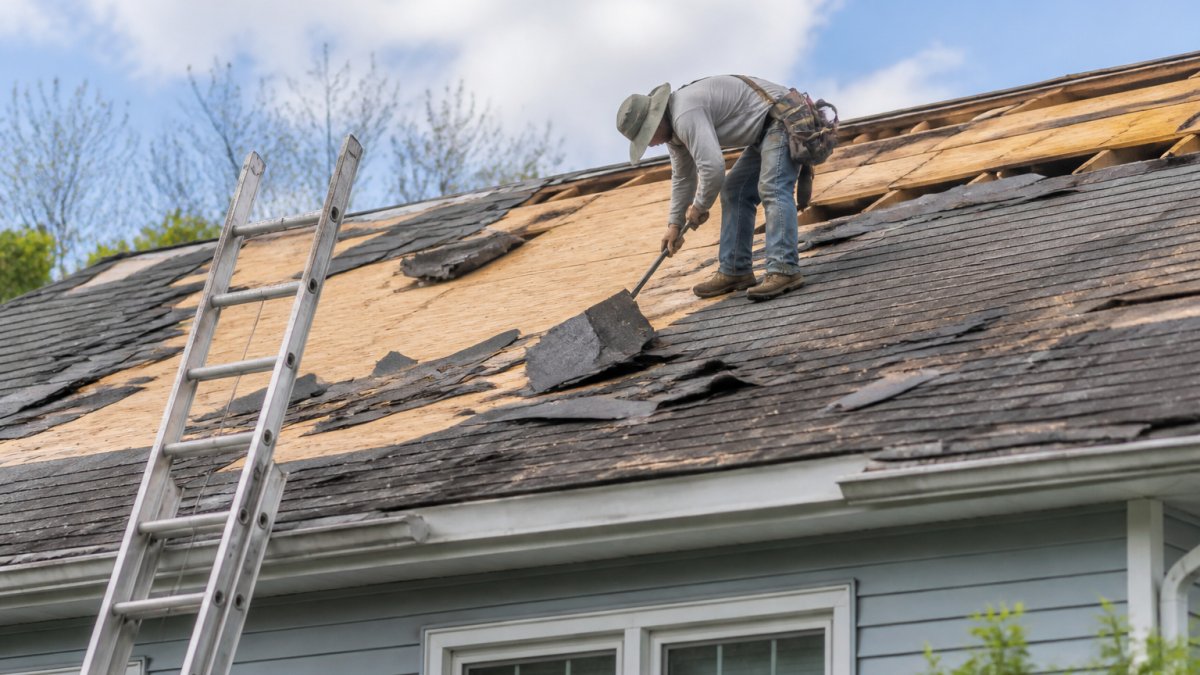
Tear-off is the removal of the existing roofing layers before new material goes on, and it is one of the line items most often buried inside a per-square price. Removing one layer is usually simpler than removing two or more, and disposal cost depends on the weight of the debris and local landfill or transfer-station fees. Once the old roof is off, the decking is inspected and any rotted or damaged boards are replaced, work that is commonly quoted separately because the true condition is not known until the old material comes off.
What a tear-off-to-inspection sequence actually looks like
A typical replacement moves through these stages, and each one can appear as its own line on a written estimate:
- Protection and staging. Tarps over landscaping, dumpster placement, and a plan for where crews and materials will sit. Tight lots and delicate landscaping add labor.
- Tear-off. Old shingles, underlayment and fasteners are removed down to the deck. A second layer roughly doubles the removal time and debris volume.
- Disposal. Debris is hauled to a transfer station or landfill. Weight-based fees mean heavier materials such as tile and slate cost more to dispose of than asphalt.
- Decking inspection and repair. The crew walks the deck, checks for soft spots, delamination and protruding fasteners, and replaces damaged sheathing. This is the line item most likely to change after work begins.
- Underlayment. A synthetic or felt underlayment goes over the deck; ice-and-water membrane is commonly required in valleys, at eaves and around penetrations.
- Flashing and edge metal. New flashing at chimneys, valleys, walls and skylights, plus drip edge at the perimeter.
- Ventilation. Ridge vent, soffit vent or other components are installed or replaced so the new roof can breathe.
- Finish material and cleanup. Shingles or panels go on, followed by a magnetic sweep for nails and a final walkthrough.
How those items show up on an itemized estimate
A transparent bid separates the scope rather than folding it into one per-square rate. A sample line-item structure, with placeholder amounts you should replace with your own local quotes, looks like this:
| Line item | What it covers | Typical treatment on a bid |
|---|---|---|
| Tear-off | Removal of existing layers | Priced per square; higher for multiple layers |
| Disposal | Dumpster and landfill fees | Priced per square or as a flat haul-away fee |
| Decking repair | Replacement of damaged sheathing | Quoted per sheet, often as an allowance |
| Underlayment | Synthetic or felt; ice-and-water membrane | Priced per square, sometimes included |
| Flashing and drip edge | Chimney, valley, wall and perimeter metal | Priced per linear foot or as a lump sum |
| Ventilation | Ridge and soffit vent components | Priced per linear foot or per unit |
| Permits | Local permit and inspection fees | Pass-through or included |
| Labor and material | Installation of the finish roof | The per-square rate most quotes lead with |
| Contingency | Unforeseen repairs | Often 10% of the project, stated or not |
When you compare bids, convert each one to this structure. A bid that shows only a per-square rate and a total is not comparable to one that itemizes tear-off, disposal, decking and flashing, because you cannot tell which scope items are included.
Watch out: an unusually low per-square rate frequently assumes one layer of tear-off, no decking repair and reuse of existing flashing, confirm those assumptions in writing before signing.
Why this matters for the per-square-foot number
The per-square-foot figure you see advertised is usually the labor-and-material rate for the finish roof, not the all-in project cost. Adding tear-off, disposal, decking allowance, flashing, ventilation and permits can move the effective cost per square well above the headline. That is not a bait-and-switch if the bid discloses it, it is a scope difference. The fix is to ask every contractor to quote the same itemized scope, then compare the totals line by line.
Factors That Change Your Roof Replacement Cost
Several variables move the final number up or down:
- Roof size and total roofing squares, measured as surface area rather than floor area. Before committing, consider whether replacing the roof is worth the investment for your home.
- Roof pitch and slope, since steeper roofs take longer and require more safety equipment.
- Roof complexity, including the number of valleys, hips, dormers and penetrations.
- Number of existing layers that must be removed before installation.
- Material selection and the grade of shingle or panel chosen.
- Accessibility and site conditions, such as tight lots, limited staging space or delicate landscaping.
- Deck condition, since rotted or damaged decking adds repair work.
- Additional repairs uncovered during the job, such as damaged fascia or soffit.
- Local labor rates and regional pricing differences.
- Timing and scheduling, which can affect availability and pricing.
Roof Replacement Cost Calculator: How to Estimate Your Project
A simple way to estimate your project is to measure or obtain your roof's surface area, convert it to roofing squares, and multiply by a rate range confirmed from written quotes in your area.
An online calculator can help with this arithmetic, but the inputs matter more than the tool. Enter accurate roof area, the material you are considering, and the scope items you expect, then compare the output with actual bids rather than treating it as a final price.
Roof Replacement Estimate Checklist for Comparing Quotes
When you collect estimates, check that each one covers the same items:

- Roof area stated in squares, and how it was measured
- Material type, brand, grade and warranty
- Tear-off of existing layers and number of layers removed
- Disposal and haul-away fees
- Decking inspection and repair pricing, quoted separately if unknown
- Underlayment, flashing, drip edge and ventilation
- Permits and inspection fees
- Cleanup and magnetic debris sweep
- Payment schedule, deposit and financing terms
A written, itemized quote makes differences between bids easy to spot. Vague totals with no breakdown are hard to compare and often hide the items that drive the final invoice.
Booking Your Roof Replacement Estimate With Taylor-Made Roofing
If you are ready to compare pricing for your home, check the Taylor-Made Roofing website for current pricing or a quote. Flexible financing options through the PACE Program, Home Run Financing and Enhancify are available to help make essential home protection more accessible. Contact Taylor-Made Roofing to learn more about your roof.
Frequently Asked Questions
How much does residential roof replacement cost per square foot?
Residential roof replacement cost per square foot varies with material, roof pitch, complexity and local labor rates, so no single figure applies to every home. Steep or multi-level roofs add labor. Because prices depend on these variables and on local conditions, the most reliable figure is a written estimate based on your actual roof measurements. Check the Taylor-Made Roofing website for a quote that reflects your roof and site.
What is included in the cost per square foot to replace a roof?
A per-square-foot price usually covers materials, labor and installation of the roof surface, but it may or may not include tear-off of the old roofing, disposal, underlayment, flashing, ridge vent and deck repairs. Always confirm line by line what a quote includes before comparing it with another.
Does roof replacement cost include removing the old shingles?
It depends on the quote. Many full replacement estimates include tear-off and disposal of the existing roofing, while some lower advertised prices cover only the new installation. If an estimate does not list removal, ask whether tear-off and disposal are extra. Check the Taylor-Made Roofing website for current pricing for your specific project.
How can I estimate my roof replacement cost?
Start by measuring or obtaining the roof surface area, which is usually larger than the home's floor area once pitch is included. Then multiply by a per-square-foot range for your chosen material, and add allowances for tear-off, decking repairs and complexity. This gives a rough planning range only. For a dependable number, request a written estimate from a licensed contractor and compare it against the checklist in this guide.