 How-to
7 Steps to Verify Roofing Contractor Credentials
Last Updated: November 5, 2026
Quick Summary
To verify roofing contractor credentials, search your state licensing board's database by license number and confirm the status is active and covers roofing work. Then request an insurance certificate from the contractor's agent, confirm general liability and workers' compensation are current, and check the state portal for complaint history.
- Search the state licensing board's database by license number first, then by business name.
- An expired, suspended, or revoked license is a hard stop until resolved.
- Request the certificate of insurance from the agent, not the contractor, and call to confirm it.
- Ask for per-occurrence and aggregate limits on general liability and workers' compensation policies.
- Look for patterns in complaint history, not single disputes over delays.
Table of Contents
- Why Verifying Roofing Contractor Credentials Matters Before You Sign
- Start With a Roofing License Lookup in Your State
- How to Verify a Roofing Contractor's Insurance and Coverage Limits
- Check a Roofing Contractor's Complaint History and Disciplinary Record
- Your Roofing Contractor Credentials Checklist for Cross-Checking Documents and Identity
- Red Flags and Verification Scams That Catch Homeowners Off Guard
- Book a Credential-Verified Roof Inspection With Taylor-Made Roofing
- Frequently Asked Questions
Why Verifying Roofing Contractor Credentials Matters Before You Sign
A contractor who knocks on your door after a storm and offers a "today only" price is the classic reason homeowners need to learn how to verify roofing contractor credentials.
Roofing contractor credentials are the paper trail that proves a company is licensed, insured, and accountable.
Below, we walk through the steps to take before signing anything, including the lookup fields to use and the red flags that should end the conversation.
Start With a Roofing License Lookup in Your State
Every state handles roofing licenses differently. Some issue a dedicated roofing license. Others require a general contractor license with a roofing classification. A few have no statewide license at all and leave it to counties or cities.
Start at your state licensing board's website, not the contractor's own site. Most boards run an online license database you can search for free.
Searching by License Number vs. Business Name
Search by license number first. It is faster and returns one exact match. Ask the contractor for the number in writing, then type it into the lookup yourself.
Search by business name second. This catches a few things the number search hides:
- Whether the license is tied to the company name on the contract
- Whether the same owner has other licenses under different names
- Whether the business name matches the one on the insurance certificate
A common mistake is trusting a license number printed on a business card. Anyone can print a number. Only the state portal confirms it belongs to a real, active license holder.
Reading License Status, Expiration, and Restrictions
The lookup result tells you more than "yes" or "no." Read every field, and treat each status as a decision point:
- Active: The license is current and the contractor may legally contract and pull permits for the classifications shown. Confirm the classification covers roofing, not just general repairs.
- Expired: The contractor cannot legally pull permits or perform permitted work. An expired license is a hard stop until it is renewed and the portal reflects the renewal.
- Suspended: The board has temporarily removed the right to work, often pending a complaint or disciplinary action. Do not sign and do not pay a deposit.
- Revoked: The board has permanently removed the license. Walk away.
Check the expiration date against your project start date, not today's date. A license that expires in three weeks may lapse before your roof is finished.
What to Do When the Lookup Does Not Match
Mismatches are where most homeowners stop checking, and where fraud hides. Work through these cases in order:
- Name on the license does not match the name on the contract. Ask the contractor to explain the relationship in writing, subsidiary, trade name, or authorized officer. If they cannot, treat it as a red flag.
- License number returns a different business. This is the classic borrowed-license scam. The number is real, but it belongs to another company. Do not proceed.
- License is active but the classification excludes roofing. The contractor may be licensed for general work but not authorized for roof replacement. Confirm the classification before signing.
- No record found. Ask for the exact legal business name and license number in writing, then search again. If the record still does not appear, assume the license does not exist.
Cross-Check the License Holder, Contract, and Payment Recipient
The strongest identity check is a three-way match: the license holder on the state record, the business name on the written contract, and the name on the payment recipient (check, invoice, or financing agreement).
A suspended license is a hard stop. So is a license with restrictions that exclude roof replacement. Walk away.
Each license status in the state lookup result is a decision point, so read it before you sign anything.
| License status | What it means | What to do |
|---|---|---|
| Active | Current and legal for the classifications shown | Confirm classification covers roofing |
| Expired | Cannot legally pull permits or do permitted work | Hard stop until renewed |
| Suspended | Right to work temporarily removed by the board | Do not sign or pay a deposit |
| Revoked | License permanently removed by the board | Walk away |
| Restricted | Limits job value, work types, or requires supervision | A no if it excludes roof replacement |
How to Verify a Roofing Contractor's Insurance and Coverage Limits
A license proves the contractor registered with the state. It does not prove they can pay for damage they cause. That is what insurance does, and you need to verify it yourself, including the limits, not just the presence of a policy.
Ask for a certificate of insurance sent directly from the contractor's insurance agent, not a photocopy the contractor hands you. Then call the agent's number on the certificate to confirm it is current.
The Policies That Matter and the Limits to Ask About
Two policies matter most:
- General liability insurance covers damage to your home or a neighbor's property if the crew causes it. Ask for the per-occurrence and aggregate limits, and confirm the policy is current.
- Workers' compensation covers injuries to crew members on your roof. Without it, an injured worker could come after you. Confirm the policy is active and covers roofing work, which is a higher-risk classification than general carpentry.
Ask the agent one direct question: "If this crew damages my roof or someone gets hurt, what does this policy cover, and what is the limit?" Write down the answer. A contractor who cannot produce a certificate from an agent is not insured, no matter what they tell you.
Additional Insured and Certificate Details
Ask whether you can be named as an additional insured on the general liability policy for the duration of the project. Not every insurer will do this for a homeowner, but the request itself is a useful test: a contractor who carries proper coverage usually knows how to answer, and one who does not will deflect. On the certificate, check the named insured, the policy effective and expiration dates, and the insurer's contact information.
Bonding and Business Registration
Insurance is not the only financial backstop. Depending on your state and locality, a roofing contractor may also need a surety bond or a business registration. A surety bond is a third-party guarantee that pays out if the contractor fails to perform or violates licensing rules. Ask for the bond number and the surety company, then confirm it with the surety directly.
A Quick Verification Sequence
- Request the certificate of insurance from the agent, not the contractor.
- Call the agent and confirm general liability and workers' compensation are current.
- Ask for per-occurrence and aggregate limits and write them down.
- Ask whether you can be named as an additional insured.
- Request the bond number and surety company, then confirm with the surety.
- Confirm the business registration matches the contract and the license record.
Watch out: a certificate that lists a different business name than the contract is a mismatch worth resolving before work begins, even if the policy itself is real.
Check a Roofing Contractor's Complaint History and Disciplinary Record
A clean license lookup does not mean a clean history. The state board also keeps a record of complaints and disciplinary actions. Search the contractor's name and license number in that section of the portal.
Look for patterns, not one-offs. A single dispute over a delay is normal. Repeated complaints about leaks, unfinished work, or unpaid subcontractors are a warning.
Also check your state's consumer protection office and the local Better Business Bureau (How to file a complaint about a company’s products or services). If you want to know what poor workmanship looks like in those complaints, our guide on how to spot poor roofing workmanship walks through the seven warning signs homeowners report most often.
Your Roofing Contractor Credentials Checklist for Cross-Checking Documents and Identity
A license number and an insurance certificate are only useful if they belong to the person standing in front of you. This is where most homeowners stop checking, and where fraud hides.
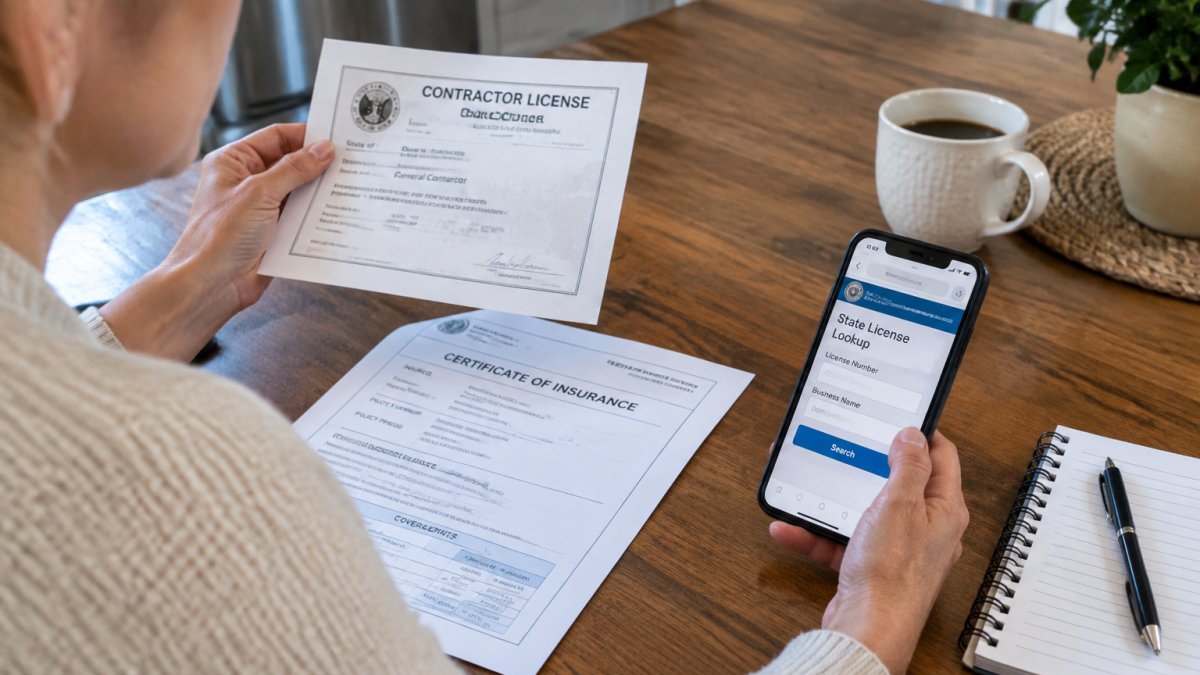
Use this checklist before any deposit changes hands:
- License number matches the business name on the contract
- License status is active and covers roofing work
- Insurance certificate came from the agent, not the contractor
- Agent confirmed general liability and workers' comp are current
- Complaint history checked on the state portal
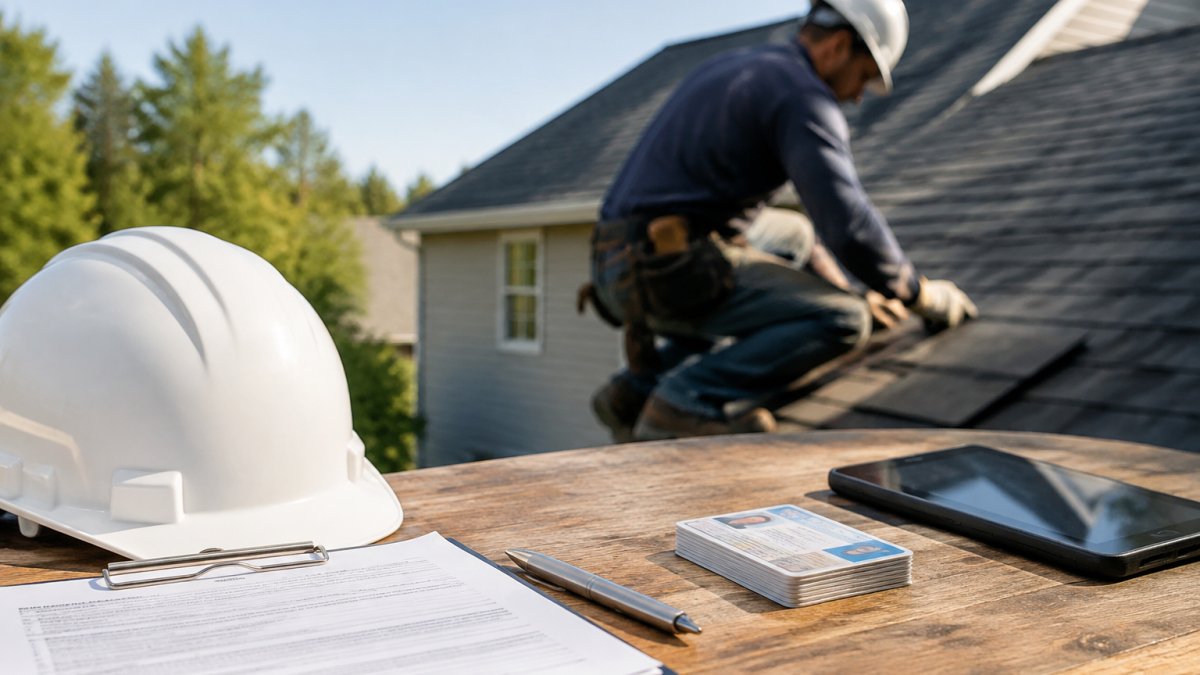
The identity check matters. Ask for a photo ID and compare the name to the license holder on the state record.
Red Flags and Verification Scams That Catch Homeowners Off Guard
The most common scam is a real license number borrowed from another company. The number checks out, but it belongs to a different business.
Watch for these warning signs:
- A contractor who pressures you to sign before you check anything
- A license number that does not match the company name on the contract
- No physical business address, only a phone number
- A request for a large cash deposit upfront
- Insurance paperwork that looks photocopied or edited
These are the same tactics that show up in verification scams year after year. Our guide on how to avoid roofing repair scams covers the full playbook, including the fake-credential tricks that follow a bad check.
Book a Credential-Verified Roof Inspection With Taylor-Made Roofing
You now have a repeatable way to check any roofing contractor before you sign. The last step is choosing a company that expects the check and passes it without hesitation.
Flexible financing options, including the PACE Program, Home Run Financing, and Enhancify, may be available to help make a needed roof replacement more accessible. If you are ready to compare bids after the credentials check out, our guide on comparing roofing contractor quotes shows how to line them up fairly.
When you are ready, book a professional roof inspection and see what to expect before anyone climbs a ladder.
Frequently Asked Questions
How do you know if a roofing contractor is licensed?
Ask for the license number, then look it up yourself on your state's licensing board website or online license database. The name on the license must match the contractor business name on your quote, the status must read active, and the expiration date must be in the future. If the contractor cannot produce a license number, or the lookup shows an expired or suspended license, walk away before discussing price.
How can I verify a roofing contractor's insurance?
Request a certificate of insurance and call the insurer's number printed on it, not a number the roofer gives you. Confirm general liability insurance and workers' compensation are both current, and ask the insurer to state the coverage limits. A legitimate roofing contractor will have the certificate sent directly from the insurer or agent, and the policyholder name should match the business name on your contract.
What should I do if a roofer's license information does not match?
Stop and ask for a written explanation before signing anything. Common mismatches include a license registered to a different business name, a license belonging to an individual rather than the company, or a status showing expired or suspended. If the contractor cannot resolve the discrepancy with documentation, treat it as a serious red flag and look for a registered roofing contractor instead.
How can I check a roofing contractor's complaint or disciplinary history?
Use your state licensing portal's complaint history or disciplinary record search, then cross-check with your state consumer protection office and the local Better Business Bureau. Look for patterns rather than a single dispute: repeated complaints about unfinished roof repair, abandoned jobs, or permit violations matter more than one resolved disagreement. Ask the contractor directly about any open complaints and get the answer in writing.